A 40ft high-cube container holds 22–26 tonnes of ringlock scaffolding when loaded to its practical payload limit — enough steel to erect roughly 1,200–1,800 m² of facade, depending on how many lifts you board. For scaffold steel the binding constraint is always weight, not volume: the same box could swallow far more steel by space, but the 30,480 kg ISO maximum gross weight — and the road limits at your destination — cut the load off long before the container looks full.
This guide gives you the numbers behind that answer: container payload tables, the component weights that drive the calculation, a worked example you can adapt to your own facade, and the packing practices that decide whether your order arrives straight or bent.
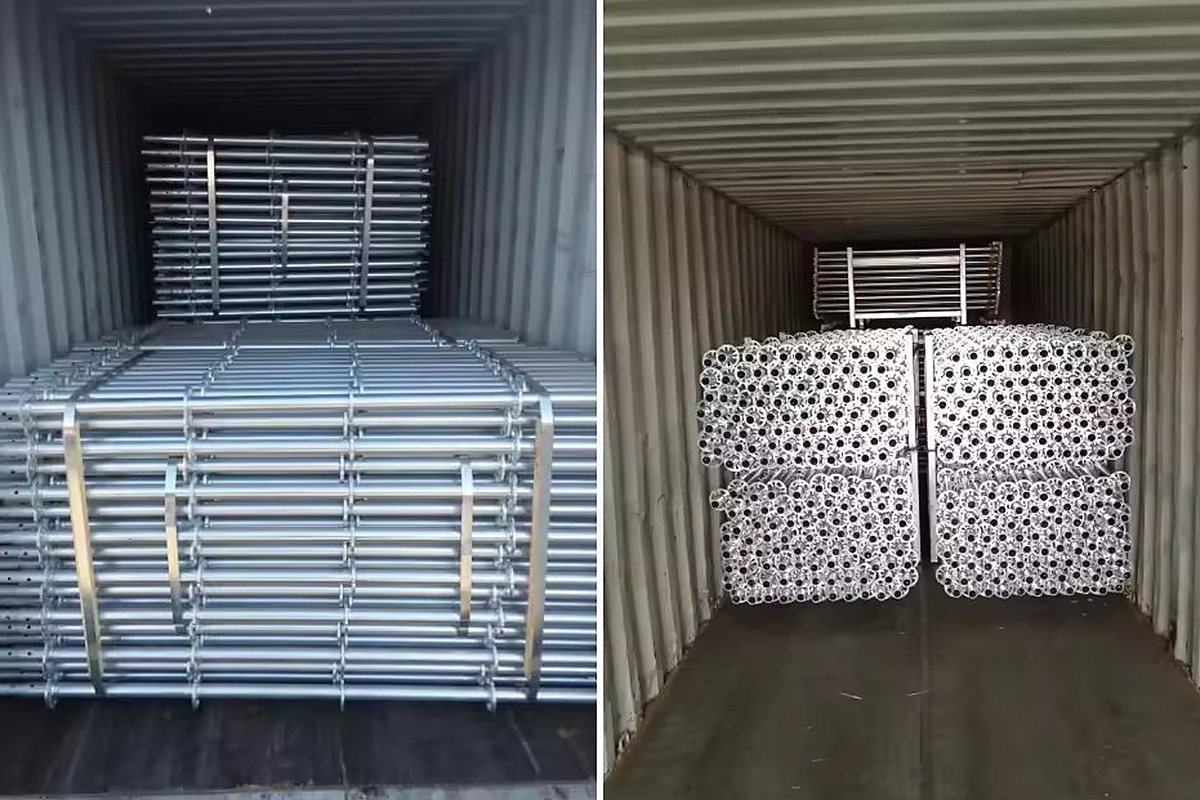
All weights below reflect the Q355B hot-dip galvanized export specification detailed in our ringlock dimensions and size chart — the same spec as our ringlock scaffolding system.
Container Payload: 20ft vs 40ft vs 40ft High Cube
| 20GP | 40GP | 40HC (High Cube) | |
|---|---|---|---|
| Internal dimensions (L × W × H) | 5.90 × 2.35 × 2.39 m | 12.03 × 2.35 × 2.39 m | 12.03 × 2.35 × 2.69 m |
| Usable volume | ≈ 33 m³ | ≈ 68 m³ | ≈ 76 m³ |
| Max gross weight (ISO 668) | 30,480 kg | 30,480 kg | 30,480 kg |
| Container tare weight | ≈ 2,230 kg | ≈ 3,730 kg | ≈ 3,900 kg |
| Theoretical payload | ≈ 28 t | ≈ 26.7 t | ≈ 26.6 t |
| Practical ringlock load | 22–26 t | 22–26 t | 22–26 t |
The practical figure sits below the theoretical one because of three real-world caps:
- VGM rules — since SOLAS verified gross mass, the declared weight must be verified before the box goes on the ship; guesswork is no longer tolerated.
- Destination road limits — many countries cap a container truck at 40–44 t gross, which leaves roughly 24–26 t of payload after the tractor and container tare.
- Safe lashing — bundles must stay below the top rail with the centre of gravity in the middle third of the box; the last tonne of space is not worth an unstable load.
Rule of thumb: plan 22–24 tonnes of ringlock per 40ft container. It leaves margin for pallets and dunnage, and it is the number most forwarders will actually accept on the bill of lading.
What 24 Tonnes Actually Builds: a Worked Example
Container loads are quoted in tonnes, but you buy scaffold in square metres of facade. Here is the bridge between the two, using the export bestseller grid — 1.8 m bays × 2.0 m lifts, double row, 6 bays wide × 5 lifts high, a facade of 10.8 × 10 m or 108 m²:
| Component | Spec | Qty | Unit weight | Subtotal |
|---|---|---|---|---|
| Standards | 2.0 m | 70 pcs | 9.7 kg | 679 kg |
| Ledgers (facade run) | 1.8 m | 60 pcs | 7.3 kg | 438 kg |
| Ledgers (transverse) | 1.2 m | 35 pcs | 5.1 kg | 179 kg |
| Diagonal braces | 1.8 × 2.0 m bay | 12 pcs | ≈ 8.5 kg | 102 kg |
| Steel planks | 1.8 m, 2 per bay | 60 pcs | ≈ 11 kg | 660 kg |
| Base jacks | 0–600 mm travel | 14 pcs | ≈ 5.6 kg | 78 kg |
| Total | ≈ 2,136 kg |
That works out to ≈ 19.8 kg per m² of facade, fully boarded. Scale it to a container load and you get the headline numbers:
| Loading scenario | Weight per m² | What a 24 t container builds |
|---|---|---|
| Fully boarded — planks on every lift | ≈ 20 kg/m² | ≈ 1,200 m² |
| Working lifts boarded (3 of 5) | ≈ 17 kg/m² | ≈ 1,400 m² |
| Frame only — planks bought locally | ≈ 14 kg/m² | ≈ 1,750 m² |
Benchmark to compare quotations: a 2.0 m standard in 3.2 mm wall Q355B weighs 9.5–10 kg. Anything quoted near 7 kg means a thinner tube — lighter per container, but it will not carry the EN 12811 load class your engineer designed to.

How a Professional Factory Loads the Container
Container loading is a core deliverable, not an afterthought. The packing spec that keeps steel straight for 30 days at sea:
- Standards — bundled hexagonally in packs of 48–72 pcs, steel-strapped at three points. A bundle of 3.0 m standards runs 1.5–2.5 t, sized for one clean forklift pick.
- Ledgers and braces — flat bundles of 30–50 pcs with wedge heads aligned to the same end, so site sorting takes minutes instead of hours.
- Steel planks — stacked flat with timber dunnage between layers; direct steel-on-steel contact is what chips galvanizing in transit.
- Jacks and small parts — palletized and cartoned (wedge pins in boxes of 50–100) so nothing loose migrates under a bundle.
- Load plan — heavy bundles over the axles, centre of gravity in the middle third, weight spread evenly left to right; everything lashed and photographed before the doors close.
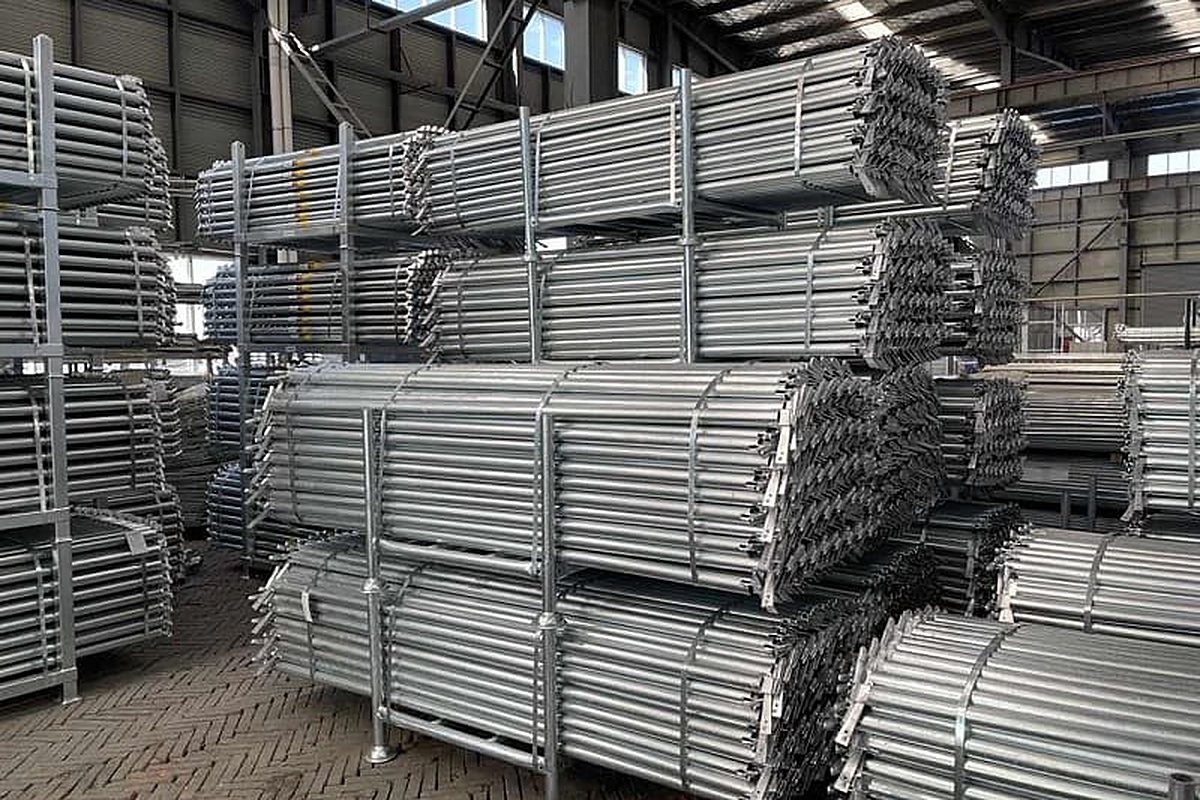
Loading is also the last quality gate: components are counted against the packing list, wedge-fit checked, galvanizing inspected, and batches marked for traceability before anything enters the box. Accurate packing lists and photos are standard with every PJSCAFFOLD shipment — they are also what keeps customs clearance fast.
20ft, 40ft or LCL: What to Book
- 40HC — the default. Lowest freight per tonne (the fixed container charge is spread over 22–26 t) and enough length for 3.0 m standards loaded lengthwise.
- 20ft — for top-ups. Carries a similar tonnage but the freight per tonne runs typically 15–25% higher; makes sense for repeat orders and yards with tight access.
- LCL — samples and gap-fills only. Groupage works down to 3–5 t but costs 2–3× per tonne and adds handling damage risk. Most factories set one full container as the MOQ for mixed orders — our ringlock price guide explains how that shapes the quote.
Freight Cost per Tonne: Indicative 2026 Ranges
| Destination | Typical transit | Indicative ocean freight / tonne |
|---|---|---|
| Middle East (Jebel Ali / Dammam) | 15–20 days | $40–55 |
| Southeast Asia | 7–12 days | $35–50 |
| North Europe (Rotterdam / Hamburg) | 30–35 days | $50–70 |
| Australia | 18–25 days | $45–65 |
| West Africa (Lagos) | 25–40 days | $60–80 |
Even at the top of these ranges, ocean freight is only 3–5% of landed product value — scaffolding steel is one of the few building materials where international purchasing stays economical at single-container scale. Ranges move with fuel and capacity, so treat them as orientation and confirm with your forwarder. We quote CIF on request; landed-cost examples are on our UAE and Saudi Arabia market pages.
FAQ
How many tonnes of ringlock scaffolding fit in a 40ft container?
A 40ft container carries 22–26 tonnes of ringlock in practice. The ISO maximum gross weight is 30,480 kg, but verified gross mass rules, destination road limits and safe lashing keep the working payload at 22–26 t.
How many square metres does one container build?
At the export-standard mix (1.8 m bays, 2.0 m lifts, Q355B), a 24 t load builds roughly 1,200 m² of fully boarded facade, or up to 1,750 m² if planks are sourced locally.
Is a 20ft or 40ft container cheaper for scaffolding?
Per tonne, a 40ft container is typically 15–25% cheaper because the fixed container charge is spread over more weight. A 20ft suits top-up orders and tight delivery yards.
Can I mix standards, ledgers, planks and jacks in one container?
Yes. Weight — not volume — is the binding constraint, so mixed loading fills the space the tubular bundles leave open. We prepare the loading plan so the mix hits payload without exceeding axle or road limits.
How is the container loaded and secured?
Standards in hexagonal bundles of 48–72 pcs, ledgers in flat bundles, planks flat-stacked on timber dunnage, jacks palletized. Loads are lashed, weight-distributed and photographed before the doors close.
Send us your facade dimensions or BOQ — we return a full take-off, the exact container loading plan and a quotation within 24 hours. Get a quote →
Frequently Asked Questions
How many tonnes of ringlock scaffolding fit in a 40ft container?
A 40ft container carries 22–26 tonnes of ringlock in practice. The ISO maximum gross weight is 30,480 kg, but verified gross mass rules, destination road limits and safe lashing keep the working payload at 22–26 t.
How many square metres does one container build?
At the export-standard mix (1.8 m bays, 2.0 m lifts, Q355B), a 24 t load builds roughly 1,200 m² of fully boarded facade, or up to 1,750 m² if planks are sourced locally.
Is a 20ft or 40ft container cheaper for scaffolding?
Per tonne, a 40ft container is typically 15–25% cheaper because the fixed container charge is spread over more weight. A 20ft suits top-up orders and tight delivery yards.
Can I mix standards, ledgers, planks and jacks in one container?
Yes. Weight — not volume — is the binding constraint, so mixed loading fills the space the tubular bundles leave open. We prepare the loading plan so the mix hits payload without exceeding axle or road limits.
How is the container loaded and secured?
Standards in hexagonal bundles of 48–72 pcs, ledgers in flat bundles, planks flat-stacked on timber dunnage, jacks palletized. Loads are lashed, weight-distributed and photographed before the doors close.