A buyer's email arrives with one line: please send your certificate. The honest answer is not a PDF five minutes later. Every certificate is issued against something — a company, a product family, a production batch or a shipment — and which of those four you are asking for decides whether the document can exist before your order, or only after it. Get that distinction wrong and you either buy paper that proves nothing, or reject a supplier who was telling you the truth.
Here is the map: the four documents that all get called "certification", what each one actually proves, the arithmetic that makes testing a volume question rather than a yes-or-no question, and what each major market asks for when the container lands.
Four Documents, Four Different Scopes
"Certificate" is used for at least four different things in this industry. They are issued by different bodies, cover different things, and none of them substitutes for another.
| Document | Typical examples | What it is issued against | Who issues it | Can it exist before your order? |
|---|---|---|---|---|
| Management-system certificate | ISO 9001, ISO 45001 | The company's processes | Accredited certification body | Yes — but it proves a system, not a plank |
| Product or type certification | CE Declaration of Performance, EN 12810 system certificate, UKCA, ECAS | A product family as designed | Notified or accredited body | Only for designs already tested |
| Batch test report | EN 10204 3.1, SGS / TÜV / BV test report | The actual production lot | Third-party laboratory or mill | No — the goods must exist first |
| Shipment conformity certificate | SASO shipment certificate via SABER, SONCAP SC, PVOC certificate of conformity | One shipment | Inspection agency under the destination scheme | No — issued after goods are ready, before loading |
The pattern is worth stating plainly, because it is where most sourcing arguments come from. The first two are about capability. The last two are about a specific parcel of steel. A supplier can show you the first two from an archive. Nobody can show you the last two for goods that have not been produced yet — and a supplier who produces them in ten minutes for a specification you have just invented is showing you someone else's paper.
Why a Batch Report Cannot Come First
A laboratory tests the object in front of it. It measures the outside diameter, the wall thickness, the steel grade from a tensile specimen, the weld and the coating thickness, then loads the sample until the deflection or the failure point tells it what the article can carry.
Change any one of those and the report stops describing what you are buying:
- A 2.4 m plank report says nothing about a 3.0 m plank at a different gauge
- A 70 µm coating report says nothing about a batch galvanized to 45 µm
- A report on 3.2 mm standards says nothing about the 3.0 mm tube some competitors quietly ship
So the sequence runs one way only: specification agreed → production run → samples drawn from that run → laboratory → report. The report is a photograph of a batch, not a property of a brand.
There is a commercial consequence too. The party who pays for the test usually owns the right to use the report, which is why a careful supplier sends either a project-specific report with your name on it, or a redacted copy of a previous one. A full, unredacted, "here is everything" package for a specification you have not ordered is a warning sign, not a convenience.
The Volume Arithmetic Nobody Puts in the Quotation
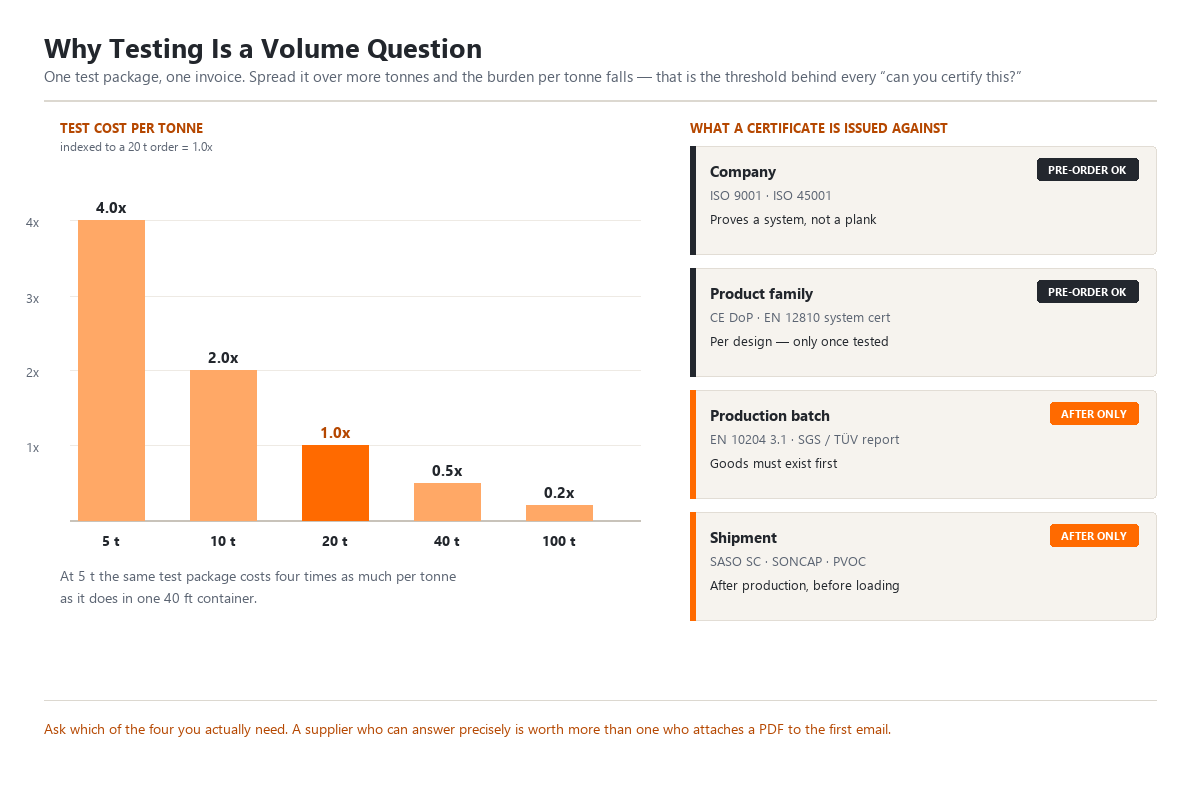
A test package is priced per standard, per laboratory and per sample set. It costs roughly the same whether you order 5 tonnes or 50. What changes is how many tonnes carry it:
| Order size | Test cost per tonne, indexed to a 20 t order | What it means commercially |
|---|---|---|
| 5 t | 4.0× | Testing can cost more than the margin on the goods |
| 10 t | 2.0× | Feasible only where the report is the point of the order |
| 20 t | 1.0× | The practical baseline — one 40 ft container |
| 40 t | 0.5× | Two containers; the burden halves |
| 100 t | 0.2× | A project package; testing is a rounding error |
This is why the answer to "can you certify this?" is a number in tonnes rather than a yes. Four things move that threshold:
- How many distinct specifications are involved. One standard tested once, or six lengths tested six times, are different purchases. Consolidating to a single wall thickness and a single coating class is usually the cheapest decision a buyer makes all year.
- Whether the design has been tested before. A specification already in our test history needs a batch report, not a full type test.
- Whether samples can be drawn from a live production run. Cutting a dedicated sample means stopping a line; drawing from an existing run does not.
- Destination scheme fees. SABER, SONCAP and PVOC charge per shipment and per inspection, not per tonne — so one consolidated shipment is far cheaper than three part-shipments.
The same logic sits behind every quotation you receive, ours included. It is also why a quotation should state these as separate lines rather than hiding them — a point we set out in what a scaffolding quotation must contain.
What We Hold, and What We Commission
We would rather tell you what we can evidence than send you a logo.
What we hold, publicly: our steel planks carry three independent reports — SGS load and deflection testing to OSHA 29 CFR 1926.451 with all items passing, SGS bending strength testing with reference to BS 2482:2009 Annex C, and TÜV Rheinland sample verification of the 2420 × 230 × 63 mm plank at 13.69 kg. The report numbers and full scans are on our certification page. Read them, including what they do not cover: they are evidence for that plank specification, not a blanket claim over every product we sell.
What we commission per order: EN 10204 3.1 mill certificates for every lot, traceable to the batch number; third-party laboratory reports on the exact specification you ordered; and destination-scheme certificates — SASO/SABER for Saudi Arabia, SONCAP for Nigeria, PVOC for Kenya — arranged through accredited agencies once the shipment is ready.
What we will not do, and you should walk away from any supplier who does:
- Send you a report for a specification that differs from your order in wall thickness, length or coating — the commonest fraud in this trade, because almost nobody measures on arrival
- Edit a scan, a date or a report number
- Issue our own "certificate" — certification is a third-party act, not something a seller prints
- Quote a certificate number that cannot be verified with the issuing body
Standards Differ by Market — Name Yours
The structural logic of a scaffold is similar everywhere. The paperwork is not. What your project file has to contain depends on two facts: the destination country and the standard named in the tender.
| Market | What the buyer normally needs | Standard basis commonly asked for |
|---|---|---|
| EU | Declaration of Performance, CE marking by the party placing the product on the market | EN 12810-1/-2, EN 12811-1; EN 74 for couplers |
| UK | UKCA marking, same technical basis as the EU route | BS EN 12810 / 12811 |
| USA | Compliance with OSHA, no CE involved; test evidence to the cited regulation | OSHA 29 CFR 1926 Subpart L, ASTM where specified |
| Saudi Arabia | Product certificate and shipment certificate through SABER | SASO technical regulation, typically on an EN or ASTM basis |
| UAE | ECAS where applicable, plus emirate-level approval for site use | EN 12810 / 12811, ESMA scheme |
| Nigeria / Kenya | SONCAP (PC + SC) or PVOC certificate of conformity, inspected before loading | SON / KEBS schemes on an EN or ISO basis |
| Australia | Test evidence to the local standard for the intended duty | AS/NZS 1576 series |
Two mistakes cost buyers real money. The first is assuming a European mark satisfies a Gulf tender — it does not; SASO is its own scheme with its own inspection. The second is assuming one certificate covers a product range — it covers a design, at a specification.
If your tender names a standard we have not tested to, the answer is not "no". It is a scoped proposal: which standard, which samples, which laboratory, what volume makes it economic — with the threshold written down before you commit.
Put the Requirement in the Purchase Order
Vague certification clauses produce vague paperwork. Six lines close the gap:
- The standard and its edition — "EN 12811-1:2003", not "EN"
- The exact specification — outside diameter, wall thickness, steel grade, coating in microns, length
- The sample and the lot — how many pieces, drawn from which production run, witnessed or not
- The laboratory and the scheme — SGS, TÜV, BV; SABER, SONCAP, PVOC
- Who pays, who owns the report, how many originals — including the right to publish it in your own tender
- What happens if it fails — retest, replacement, or credit, stated before the deposit is paid
Everything on that list is answerable in writing. If a supplier cannot answer item 2, no certificate they send afterwards will match what arrives in the container — which is why the specification comes first and the paper follows. Our EN 12810/12811 explainer covers what each standard actually governs, and the coating article covers the one number most often faked.
Tell us the destination country, the standard in your tender and the tonnage you expect, and we will reply with the document list and the volume at which testing becomes economic — before you commit to anything. Send the requirement, or start from the steel plank specification where our reports already exist.
Frequently Asked Questions
Can you send a test report before I place an order?
For specifications we already produce and hold reports on, yes — our steel plank reports from SGS and TÜV Rheinland are public on our certification page. For a new length, wall thickness or coating, no lab can issue a report against a product that has not been made yet. What we can send instead is the test plan, the standard we will test to, and the sample size we propose.
How many tonnes do I need to order before you arrange third-party testing?
It depends on how many standards and product families are involved, not on a single flat number, because the test package costs roughly the same whether the order is 5 t or 50 t. We state the threshold in tonnes, per standard, in writing before you commit — and it falls sharply once you consolidate specifications.
Which documents do you already hold and which do you commission?
Held: SGS load and deflection testing to OSHA 29 CFR 1926.451 and SGS bending testing to BS 2482:2009 Annex C on our steel planks, plus TÜV Rheinland sample verification. Commissioned per order: EN 10204 3.1 mill certificates for every lot, third-party laboratory reports on the ordered specification, and destination-scheme certificates such as SASO/SABER, SONCAP or PVOC through accredited agencies.
Is CE marking required to sell scaffolding in the EU?
It depends on the system and whether a harmonised standard or a European Technical Assessment covers that design. What your project file needs is a Declaration of Performance and the test evidence behind it. We will confirm in writing which documents we can supply for a specific order rather than assert a mark we cannot evidence.
Do different countries need different tests?
The structural logic is largely shared — EN 12810/12811 in Europe and the Gulf, OSHA 29 CFR 1926.451 in the United States, AS/NZS 1576 in Australia — but acceptance routes, marking, language and pre-shipment inspection differ. Name the standard in your tender and the destination country, and the document list follows from those two facts.