How many microns of zinc does scaffold tube actually need? For 48.3 × 3.2 mm tube, EN ISO 1461 sets a mean coating of 70 µm, with no single reading below 55 µm. That is the requirement, and it is the number that belongs in a purchase order.
Not 80. Not 120. Those numbers exist in the market — on certificates, in supplier catalogues, in WhatsApp replies — but they mean something different from what most buyers assume. Below is the table they come from, why the bigger numbers appear, and how to check a container when it lands.
It matters more than any other line on the specification. Galvanizing is the only part of a scaffold that is designed to be consumed: the zinc corrodes so the steel does not. Get the coating right and a fleet is still serviceable in year eight; get it wrong and the rust starts inside the tube, where nobody looks until it weeps out of the ends.
The Requirement, in One Table
EN ISO 1461 sets the minimum by the thickness of the steel being galvanized, not by the product. Heavier sections stay in the molten zinc longer and grow a thicker alloy layer, so the standard writes separate floors for each thickness band:
| Steel thickness of the article | Local minimum (no single reading below) | Mean minimum (average of readings) |
|---|---|---|
| under 1.5 mm | 35 µm | 45 µm |
| 1.5 mm to 3 mm | 45 µm | 55 µm |
| over 3 mm to 6 mm | 55 µm | 70 µm |
| over 6 mm | 70 µm | 85 µm |
Our 48.3 × 3.2 mm standards sit in the third row. Coating mass converts at 1 µm = 7.14 g/m², so the same requirement reads ≥ 395 g/m² local and ≥ 505 g/m² mean — the units you will see on a Chinese inspection certificate.
Two details in that table catch buyers out.
The class follows the steel, not the product line. A ringlock system mixes wall thicknesses: 3.2 mm standards, 2.5 mm ledgers, 3.2 mm braces. A 2.5 mm ledger sits one band up at 45/55 µm, so a container can be fully compliant with EN ISO 1461 and still arrive with visibly thinner coating on the horizontals. That is not a defect; it is the standard working as written. If you want one coating class across the package, say so in the enquiry, because the default is three.
Local and mean are two different tests. The local figure is a floor that no single reading may cross. The mean is the average across the reference areas. A batch that averages 78 µm and dips to 48 µm in one spot has failed — and that dip is usually at a tube end or a weld, exactly where corrosion begins. Suppliers who quote one number are quoting the flattering one.
Why Thicker Steel Holds More Zinc
Hot-dip galvanizing is not a coating applied to steel; it is a reaction with it. Once the steel is above roughly 430 °C in the zinc bath, iron and zinc interdiffuse and grow alloy layers at the surface. The reaction is time-and-temperature driven, and time is set by how long the section takes to heat through.
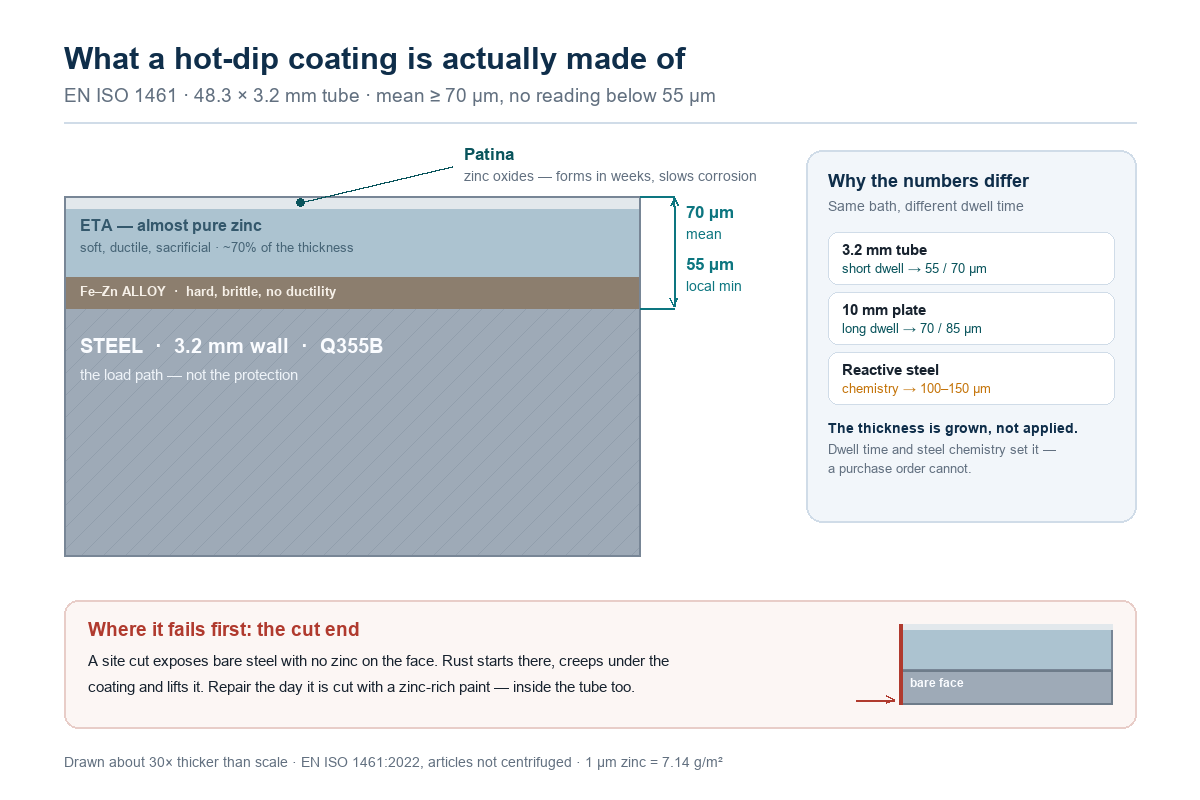
A 3.2 mm wall reaches bath temperature in a fraction of the time a 10 mm plate does, so it is withdrawn sooner and carries less alloy. That is the entire logic of the table above: the standard did not choose 55/70 for thin tube as a concession, it recorded what a controlled process reliably produces. Which is also why a supplier promising 120 µm on 3.2 mm tube is promising to beat the process, not to meet a standard.
Where "120 µm" Comes From
Four sources, all of them legitimate, none of them a specification.
It is a typical achieved value. Silicon-killed structural steel routinely galvanizes to 100–150 µm even though the floor for heavy sections is 85 µm. When a mill certificate from a 10 mm plate order says 120 µm, that is a real measurement of a real coating — on steel four times thicker than scaffold tube.
It is the silicon effect. Steel chemistry drives coating growth hard. Silicon around 0.15–0.21% pushes a coating to roughly 115 µm; silicon between about 0.03% and 0.12% (the Sandelin range) produces very thick, dull, brittle coatings. Neither is a quality upgrade. Both are a chemistry outcome that a buyer did not ask for and cannot see.
It is a measurement artefact. A magnetic gauge held near a cut end, over a dross inclusion, or on the inside curve of a tube reads high. So does a reading taken over a zinc run. Averages taken from the wrong places produce impressive numbers.
It is a marketing number. In a comparison table, 120 looks better than 70. Nothing about the number requires it to be measured, and most of the time it is not.
Why specifying it backfires
Writing "min. 120 µm" on a purchase order does not buy a better coating. It buys one of three outcomes:
- A refused or re-quoted order. The galvanizer cannot guarantee 120 µm on 3.2 mm tube without reactive steel, and a serious one will say so — after the price goes up.
- A brittle coating. The thickness above the standard is mostly iron-zinc alloy, which is hard and not ductile. Scaffold tube is dropped, strapped, stacked and hammered; a thick alloy layer flakes at cut ends and impact points, and every flake is a bare spot on bare steel.
- A rejection argument you cannot win. You will be testing with a hand-held gauge against a number nobody can verify on the inside of a tube, and the dispute will be settled by a gravimetric test that neither side wants to pay for.
There is a legitimate case for more zinc: a C5 marine site, buried sections, or a design life past 25 years with no maintenance. Then the answer is a special agreement with a specified higher thickness, or a duplex system (galvanized plus paint, which multiplies life rather than adding to it), or a different coating entirely — not a bigger number typed into a PO.
What the Coating Is Actually Made Of
A hot-dip coating is four layers, and only one of them is zinc in the ordinary sense.
From the steel outward: gamma, delta and zeta are iron-zinc intermetallics, hard and brittle, and they form at the interface during immersion. Eta is almost pure zinc, soft, ductile, and roughly 70% of the total thickness. On top of that, once the tube is in service, a thin patina of zinc oxides and carbonates forms within weeks and slows further corrosion dramatically — which is why a coating predicted to lose 2 µm in year one does not lose 2 µm in year ten.
The practical consequence is about damage, not chemistry. A scratch through the eta layer into the alloy still leaves zinc either side, and that surrounding zinc protects the exposed steel sacrificially — the reason a galvanized rack does not rust outward from a bolt hole the way painted steel does. But a cut end is different: it is bare steel with no coating anywhere on the face, and it will rust first, every time. That is why the ends of galvanized tube deserve more attention than the middle.
What Moves the Number Up or Down
- Steel chemistry (silicon and phosphorus). The single largest variable. Ask for Si and P on the mill certificate; they explain the coating you actually get.
- Surface preparation. Blasting to Sa 2½ before dipping typically adds 20–50% to coating thickness, and improves adhesion. Pickled-only steel sits at the lower end.
- Immersion time and bath temperature. Longer and hotter means more alloy. It is a process setting, not a quality setting.
- Geometry and drainage. Tube ends, overlapping faces and closed sections need vent and drain holes. Without them you get uncoated interior patches or trapped zinc; with them you get a coating you can measure.
- Withdrawal rate. Sets how much eta zinc freezes onto the surface as the article leaves the bath.
- Post-treatment. Passivation (chromate-free these days) delays white rust in transit. It does not add a single micron.
What 70 µm Buys You in Service
Coating life is estimated by dividing thickness by the first-year corrosion rate for the environment. ISO 9223 and ISO 12944-2 publish those rates for zinc:
| Corrosivity | Typical environment | Zinc loss, year 1 | Planning life at 70 µm | at 85 µm |
|---|---|---|---|---|
| C1 very low | heated, dry interior | ≤ 0.1 µm | over 100 years | over 100 years |
| C2 low | rural inland, arid desert | 0.1–0.7 µm | 100+ years | 120+ years |
| C3 medium | urban, light industrial, coast away from surf | 0.7–2.1 µm | 33–100 years | 40–121 years |
| C4 high | industrial, coast with moderate salinity | 2.1–4.2 µm | 17–33 years | 20–40 years |
| C5 very high | high-salinity coast, aggressive industry | 4.2–8.4 µm | 8–17 years | 10–20 years |
| CX extreme | offshore, splash zone | 8.4–25 µm | 3–8 years | 3–10 years |
Read this as a planning floor, not a warranty. Dividing by the first-year rate is deliberately conservative: zinc corrosion slows once the patina stabilises, and ISO 14713-1 gives longer estimates for that reason. It is also optimistic in one respect — it assumes the coating stays intact, and a scaffold coating does not. Bundles rub against each other, planks slide on tubes, base jacks sit in grit, and desert sand blasts exposed edges. On a fleet that lives outdoors, moved twice a week, derate the table by roughly one category.
That is why the honest answer to "how long will it last" is a range tied to a place. We quote 10+ years of outdoor service in temperate and rural conditions as the floor we will stand behind, and say plainly that a Gulf coastal yard will see the end of a 70 µm coating sooner than an inland one. For a C5 site the sensible specification is not 120 µm on thin tube — it is a duplex system, or a planned maintenance interval.
Where the Coating Fails First
In the field, almost never in the middle of a standard. The order is consistent:
- Cut ends. Site-cut tube has a bare steel face. It rusts, the rust creeps under the adjacent coating, and the coating lifts. Repair with a zinc-rich paint the day it is cut.
- Drilled holes and welded repairs. Same mechanism, plus heat damage around a weld. Zinc must be ground back before welding anyway — welding through galvanizing produces zinc fume, which is a health issue before it is a coating issue.
- Tube interiors. Internal coating is thinner, rougher and almost never measured. Water sits inside a horizontal ledger, and the first sign is a rust stain at the end cap.
- Abrasion points. Bundle straps, fork pockets, the ground contact face of base jacks.
- White rust from wet packing. Not a thickness failure — zinc hydroxide from moisture trapped between tubes in a sealed container. It looks alarming, cleans off, and is prevented by dry packing, dunnage and ventilation rather than by more zinc.
How to Check a Delivery
A container of galvanized steel can be checked in half an hour with a gauge and a certificate.
- Read the certificate first. EN 10204 3.1 inspection certificate, listing reference-area results, the steel thickness class, and mill certificates with Si and P. A datasheet saying "hot-dip galvanized to EN ISO 1461" is a claim, not a result.
- Measure with a magnetic gauge to EN ISO 2178. At least five readings per 10 cm² reference area, away from cut ends, edges and visible runs.
- Judge mean and local separately. Mean against 70 µm, lowest single reading against 55 µm. Both tests, or the number is not the standard's number.
- Measure the horizontals too. A 2.5 mm ledger is allowed 45/55 µm — confirm what class you actually bought.
- Look at the ends and the inside. A torch down a ledger tells you more about internal coating than any surface reading.
- If it is disputed, go gravimetric. Strip and weigh is the referee method: the mass difference divided by area, at 7.14 g/m² per micron. Destructive, slow, and decisive.
The Clause to Put in the RFQ
Most coating disputes are settled before they start, by one paragraph in the enquiry. This is the wording we work to, and you are welcome to lift it:
Hot-dip galvanized inside and out to EN ISO 1461:2022. On 48.3 × 3.2 mm tube: mean coating ≥ 70 µm, no individual reading below 55 µm (≥ 505 g/m² mean, ≥ 395 g/m² local). Apply the same 70/55 class to 2.5 mm wall ledgers. Coating thickness measured by magnetic gauge to EN ISO 2178, five readings per 10 cm² reference area, with reference-area results supplied on an EN 10204 3.1 certificate together with mill certificates showing Si and P. Bare areas to be renovated with zinc-rich paint per the standard. No bare cut ends shipped.
Three sentences do the work that a page of adjectives cannot: they name the standard and its edition, they give both the mean and the local figure, and they name the test that settles an argument.
The economics are worth stating too. Zinc is a real cost in a tonne of scaffolding, and coating thickness is one of the few places where a lower number is not automatically a cut corner — 70 µm is the standard, not the cheap option. If a quotation is 15% under the market, the difference is more often in wall thickness, steel grade or coupler type than in a few microns of zinc, and our price breakdown guide explains where those differences hide.
Two more pieces belong next to this one. If you are still choosing between finishes, the comparison of hot-dip galvanizing against painted scaffolding covers the five-year cost. If you are writing the whole specification, EN 12810 and EN 12811 explained covers the load classes that sit above the coating. And because coating follows the steel, the wall thickness and size chart tells you which band each component falls into — the same 3.2 mm that sets the 70 µm requirement is also what sets the tube weight per metre.
Our ringlock system is supplied hot-dip galvanized inside and out to EN ISO 1461 — mean ≥ 70 µm, local minimum ≥ 55 µm on 3.2 mm tube — and if you want one coating class across the whole package, including the 2.5 mm ledgers, say so in the enquiry and we will quote it that way. Send us the component list and the destination port, and we will come back with the coating class that suits the environment, the tonnage, and the certificate you should expect to receive — request a quotation →.
Frequently Asked Questions
How many microns of galvanizing do I need on scaffold tube?
For 48.3 × 3.2 mm tube, EN ISO 1461 requires a mean coating of 70 µm with no single reading below 55 µm (≥ 505 g/m² mean, ≥ 395 g/m² local). Thinner walls sit in a lower band: 2.5 mm ledgers are only required to reach 45 µm local / 55 µm mean.
Is 120 µm galvanizing better than 70 µm?
Not automatically. 120 µm is a typical achieved value on reactive or heavy steel, not a requirement, and on 3.2 mm tube it usually cannot be guaranteed without changing the steel chemistry. The alloy layers that carry the extra thickness are brittle, so very thick coatings flake at cut ends and under handling — which is where scaffold tube gets abused.
Does coating thickness change the strength of a scaffold tube?
Not in any practical way. At 70 µm the coating adds about 0.14 mm to the outside diameter and is not counted in the section properties; the load capacity comes from the tube diameter, wall thickness and steel grade. What thickness does affect is how long the tube survives before the wall itself starts to lose section.
How long will 70 µm of zinc last outdoors?
In a rural or arid inland atmosphere, decades. In an urban or light industrial one, roughly 30 years and up on a conservative first-year-rate calculation. On a high-salinity coast, 8–17 years. We quote 10+ years of outdoor service in temperate conditions as a floor, and recommend a duplex system where the site is C5.
How do I check galvanizing thickness on a delivered container?
With a magnetic gauge to EN ISO 2178: at least five readings per 10 cm² reference area, kept away from cut ends and edges, then compare the mean and the lowest single reading against the table. Ask for the reference-area results on an EN 10204 3.1 certificate — a single number on a datasheet is not evidence.
Explore Our Scaffolding Systems
Ringlock Scaffolding
View details →Cuplock Scaffolding
View details →Frame Scaffolding (H-Frame)
View details →Hot-Dip Galvanized Steel Planks
View details →Connectors & Accessories
View details →Keep Reading
- EN 12810 and EN 12811 Explained: What European Scaffolding Standards Mean for Your Order
- Test Reports and Certification for Scaffolding: What You Can Ask For, and When
- How to Install Ringlock Scaffolding: Step-by-Step Erection Sequence
- How to Read a Scaffold Load Chart: Ringlock Allowable Load Tables Explained