A 48.3 × 3.2 mm scaffold tube weighs 3.56 kg per metre. That single number answers most of the weight questions that come up in a scaffolding order — but only if you know where it stops being true. A 2.0 m standard is not 7.1 kg of tube: it is 9.7 kg, because four rosettes and a spigot are welded onto it.
This guide gives you the formula, the chart by wall thickness, and the gap between theoretical tube weight and certified component weight — which is exactly the gap that makes container plans come up short.
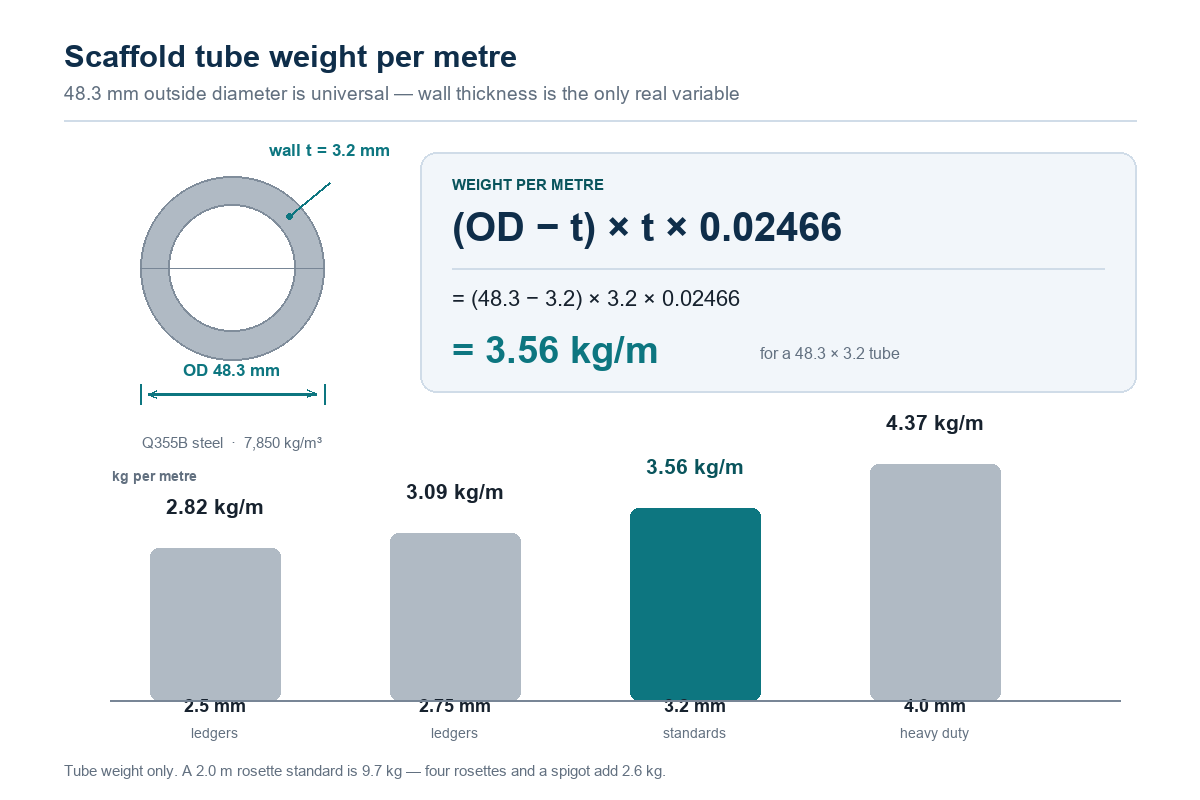
The Formula, and Why It Works
Any steel tube can be weighed on paper with one line:
Weight per metre (kg/m) = (OD − t) × t × 0.02466
where OD is the outside diameter in mm, t is the wall thickness in mm, and 0.02466 folds together π, the steel density of 7,850 kg/m³ and the unit conversions. It is the same formula used for pipes and hollow sections worldwide, so it does not depend on which supplier you buy from.
For the standard scaffold tube:
(48.3 − 3.2) × 3.2 × 0.02466 = 3.56 kg/m
Two caveats before you use it in a quotation. First, it assumes 7,850 kg/m³ — Q355B and S355JR sit within about 1% of that, so the assumption is safe. Second, it is nominal: it uses the wall thickness written on the drawing, not the wall that arrives on site.
Weight Per Metre by Wall Thickness
Wall thickness is the only variable that matters much here, because 48.3 mm is the near-universal scaffold tube diameter (it is 1.9 in, the historic imperial size, and it is what EN 12811 test data is built around).
| Wall thickness | kg per metre | 3 m length | 6 m length | Typical use |
|---|---|---|---|---|
| 2.5 mm | 2.82 kg | 8.47 kg | 16.94 kg | Ledgers, light horizontals |
| 2.75 mm | 3.09 kg | 9.27 kg | 18.53 kg | Ledgers, braces |
| 3.2 mm | 3.56 kg | 10.68 kg | 21.35 kg | Standards (verticals) |
| 4.0 mm | 4.37 kg | 13.11 kg | 26.22 kg | Heavy-duty shoring, high load classes |
The jump from 2.5 mm to 3.2 mm is 26% more steel for the same length. That is why "48.3 tube" on a quotation means very little on its own — the wall thickness is the specification.
Theoretical Tube Weight vs Certified Component Weight
This is the part buyers get wrong. A rosette standard is a tube with discs welded to it at 500 mm centres, and each disc is real steel: roughly 135 mm diameter, 10 mm plate with eight punched slots.
| Component | Tube weight (nominal) | Certified weight | Difference |
|---|---|---|---|
| 0.5 m standard (1 rosette) | 1.78 kg | 2.8 kg | +1.0 kg |
| 1.0 m standard (2 rosettes) | 3.56 kg | 5.1 kg | +1.5 kg |
| 1.5 m standard (3 rosettes) | 5.34 kg | 7.4 kg | +2.1 kg |
| 2.0 m standard (4 rosettes) | 7.12 kg | 9.7 kg | +2.6 kg |
| 2.5 m standard (5 rosettes) | 8.90 kg | 12.1 kg | +3.2 kg |
| 3.0 m standard (6 rosettes) | 10.68 kg | 14.3 kg | +3.6 kg |
Read the difference column: it grows by about 0.52 kg per 500 mm of length, which is one rosette plus its weld. There is also a small fixed addition — the spigot at the top and the end detail at the base — of roughly 0.45 kg, which is why the 0.5 m standard is 1.0 kg over rather than 0.55 kg.
The practical rule: for a standard, add roughly 35% to the tube weight. For a 1.8 m ledger the addition is different again, because a ledger carries two forged wedge heads instead of rosettes — which is why the certified 1.8 m ledger is 7.3 kg against 5.1 kg of tube. Use the certified table in our ringlock size chart rather than deriving component weights yourself.
Three Places This Number Decides Money
1. Container loading. If you plan a 24 t container on tube weights alone you will under-order by roughly a quarter of a tonne per tonne. The full method — including how many square metres a container actually builds — is in our container loading guide.
2. Spotting a thin-wall quotation. A 2.0 m standard quoted at 7.0–7.5 kg is not a bargain, it is a 2.5 mm tube or thinner. It is lighter to ship and cheaper per tonne, but it will not deliver the load class your engineer designed to, and it will not interchange safely with a heavier system on the same site. The same logic applies to the small parts: couplers, wedges and pins in our connectors and accessories range are specified by load grade, not by feel.
3. Manual handling and erection rate. A 3.0 m standard at 14.3 kg is a two-person lift on most sites; at 2.0 m and 9.7 kg it is one. Crews erect faster with the shorter standard and more lifts, which is why the 2.0 m / 2.0 m step combination dominates export orders.
Metres and Pieces Per Tonne
When you are converting a tonnage into a purchase order, this is the direction you need:
| Tube / component | Weight | Per tonne |
|---|---|---|
| 48.3 × 3.2 tube | 3.56 kg/m | 281 m |
| 48.3 × 2.5 tube | 2.82 kg/m | 354 m |
| 2.0 m rosette standard | 9.7 kg | 103 pcs |
| 1.8 m ledger | 7.3 kg | 137 pcs |
| 1.2 m ledger | 5.1 kg | 196 pcs |
| 1.8 m steel plank | 11 kg | 91 pcs |
Piece counts are what turn a tonnage into a shipping list — and they are the reason a full bill of materials is worth building before you negotiate, as set out in our 1,000 m² component list.
Tolerances: Why the Scale Disagrees With the Drawing
EN 10219 allows a wall thickness tolerance of about ±10% on cold-formed hollow sections, and mass tolerance on a bundle is typically ±5–10% depending on the standard invoked. A nominal 3.2 mm tube at the bottom of tolerance is 2.88 mm — 3.2 kg/m instead of 3.56 kg/m.
That is not automatically a defect; it is what the standard permits. But it means two things for a buyer:
- Compare quotations on measured wall thickness from an inspection report, not on the nominal figure in the offer.
- Expect the vessel's weight at destination to differ slightly from your calculated figure. Budget the container at 22–24 t rather than at the theoretical maximum, so a 5% swing does not turn into a re-handling charge.
If weight consistency matters to your project — for instance when the same tonnage has to build a known facade area — say so at enquiry stage. We supply mill certificates and measured wall readings with every shipment, and we will quote the wall thickness the mill can actually hold rather than the one that reads best on paper.
Need the weight breakdown for a specific mix of lengths? Send us the schedule and we will return the piece counts, the total tonnage and the container plan. Request a weight and loading check →
Frequently Asked Questions
How much does a scaffold tube weigh per metre?
A 48.3 mm tube with 3.2 mm wall weighs 3.56 kg per metre. The same tube in 2.5 mm wall weighs 2.82 kg/m, and in 4.0 mm wall 4.37 kg/m. These are theoretical figures for steel at 7,850 kg/m³.
What is the formula for steel tube weight per metre?
(OD − t) × t × 0.02466, where OD and wall thickness t are both in millimetres and the result is kg per metre. For 48.3 × 3.2: (48.3 − 3.2) × 3.2 × 0.02466 = 3.56 kg/m.
Why does a 2.0 m scaffold standard weigh 9.7 kg when the tube alone is only 7.1 kg?
Because a standard is not just a tube. Four rosette discs are welded on at 500 mm centres (about 0.55 kg each) plus the spigot and end detail, adding roughly 2.6 kg to the 2.0 m length. Always use certified component weights, not tube weights, for container planning.
How many metres of scaffold tube are in one tonne?
About 281 m of 48.3 × 3.2 mm tube per tonne, 354 m at 2.5 mm wall, or 229 m at 4.0 mm wall.
Does the wall thickness tolerance change the weight I pay for?
Yes. EN 10219 permits a wall thickness tolerance of roughly ±10%, so a nominal 3.2 mm tube can legitimately arrive at 2.9 mm. That is a 9% swing in weight and in load capacity — ask for the mill certificate and the actual measured wall on the inspection report.