A 1.8 m galvanized steel scaffold plank weighs about 11 kg — which is roughly 10 kg of steel per square metre of platform. That is the number to carry in your head, because it converts a plank count into tonnage and tonnage into container space without needing a catalogue.
It is also about half the weight of the timber board it replaces, per square metre. The reason is simple: a steel plank is a folded hollow profile, not a solid section.
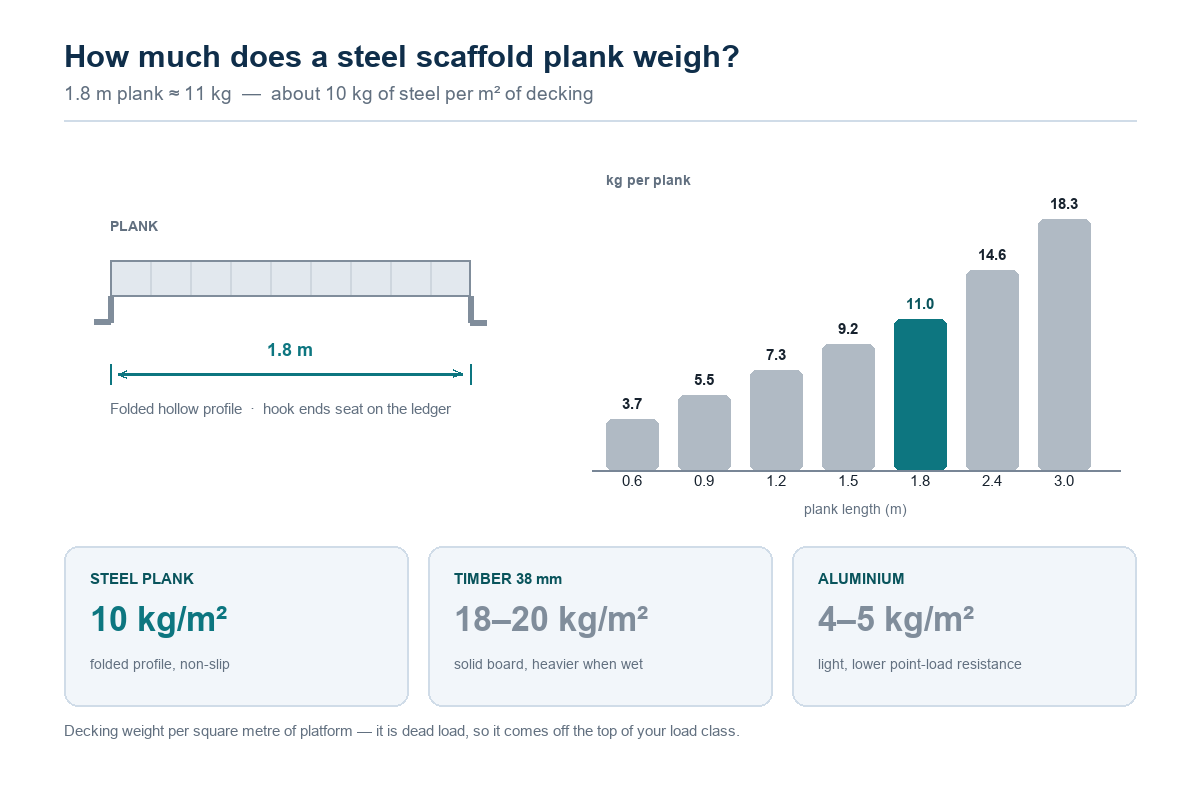
Weight by Length
Plank weight scales almost linearly with length, because the profile section is constant. Using the certified 1.8 m / 11 kg reference in the 0.61 m decking module, that is 6.1 kg per metre of plank length:
| Plank length | Weight (0.61 m module) | Covers | Weight (1.07 m module) |
|---|---|---|---|
| 0.6 m | ≈ 3.7 kg | 0.37 m² | ≈ 6.4 kg |
| 0.9 m | ≈ 5.5 kg | 0.55 m² | ≈ 9.6 kg |
| 1.2 m | ≈ 7.3 kg | 0.73 m² | ≈ 12.8 kg |
| 1.5 m | ≈ 9.2 kg | 0.92 m² | ≈ 16.1 kg |
| 1.8 m | 11.0 kg | 1.10 m² | ≈ 19.3 kg |
| 2.4 m | ≈ 14.6 kg | 1.46 m² | ≈ 25.7 kg |
| 3.0 m | ≈ 18.3 kg | 1.83 m² | ≈ 32.1 kg |
The 1.8 m length dominates export orders because it matches the 1.8 m bay of the standard ringlock grid: one or two planks close out a bay without cutting, and a single plank stays inside a comfortable one-person lift. Beyond 2.4 m the plank needs a support mid-span or a heavier profile, so long lengths are usually specified for special applications rather than general facade work.
Decking Weight Per Square Metre
The per-metre figure is useful for handling; the per-m² figure is what goes into a load calculation.
| Decking type | Weight per m² | Notes |
|---|---|---|
| Folded steel plank | ≈ 10 kg/m² | Hot-dip galvanized, hook or lip ends, non-slip perforations |
| Solid timber board, 38 mm | ≈ 18–20 kg/m² | Absorbs water, weight rises further when wet |
| Aluminium plank | ≈ 4–5 kg/m² | Lighter to handle, lower point-load resistance, higher cost |
Two 1.8 m steel planks deck a 1.8 × 1.2 m bay: 22 kg of decking across 2.16 m² of platform. That is the figure that appears in a bill of materials — and it is why the same 1,000 m² of facade needs 560 planks and 6.2 tonnes of decking in our 1,000 m² component list.
What Decking Costs You in Load Capacity
Decking is dead load, so it comes straight off the top of your platform class before anyone stands on it.
| EN 12811 class | Uniform load | Allowance in kg/m² | Taken by 10 kg/m² decking | Remaining |
|---|---|---|---|---|
| Class 1 | 0.75 kN/m² | 76 kg/m² | 13% | 66 kg/m² |
| Class 2 | 1.5 kN/m² | 153 kg/m² | 7% | 143 kg/m² |
| Class 3 | 2.0 kN/m² | 204 kg/m² | 5% | 194 kg/m² |
| Class 4 | 3.0 kN/m² | 306 kg/m² | 3% | 296 kg/m² |
| Class 5 | 4.5 kN/m² | 459 kg/m² | 2% | 449 kg/m² |
The practical reading: on a Class 3 facade platform, choosing steel over a wet timber board buys back roughly 5–10 kg/m² of allowance — worth having if you are stacking stone or cladding units, and irrelevant if you are only running hand tools. The load method itself, including wind and the factors that apply, is set out in our load calculation basics.
What Governs a Plank's Rating
Four things, in this order:
- Span. A plank is a simply supported beam between two ledgers. Capacity falls roughly with the square of the span, so a plank rated at 1.8 m does not become a 3.6 m beam with half the load — it becomes an unsafe one.
- The section. Sheet thickness and fold depth drive stiffness. Two planks of the same external dimensions can differ by 40% in stiffness depending on the sheet gauge and profile, which is why weight per metre is a reasonable proxy for quality but not a proof of it.
- End engagement. Hook ends or lips must seat fully on the ledger. A plank resting on a rosette rather than a ledger has no reliable restraint and no rated capacity.
- Surface condition. A heavily deformed or corroded plank loses section. EN ISO 1461 galvanizing at mean ≥ 70 μm on the tube and equivalent protection on the plank is what keeps that from happening in the first place — see our size chart for the coating specification across the range.
Planks and Container Space
Steel planks are the volume-efficient part of a scaffolding order and the weight-efficient part: they stack flat, nest tightly, and load at roughly 1.5–1.8 tonnes per stack of bundling on timber dunnage. In a mixed 24 t container the planks are normally the last item loaded and the one that decides whether the doors close — see the container loading guide for how the mix is planned.
For decking volumes, our steel plank range covers the 0.61 m and 1.07 m modules in 1.8 m through 3.0 m lengths, all hot-dip galvanized to EN ISO 1461.
Matching Planks to the Rest of the Order
Three checks before you buy decking for a ringlock frame:
- Module match. The plank width has to close out your bay width. A 0.61 m plank in a 1.2 m bay leaves an open gap that fails the platform requirement.
- Hook compatibility. Plank ends are system-specific. Ringlock planks with hooks that engage the ledger will not seat correctly on a cuplock or frame system without the right bearer.
- Length vs bay. Order the plank length to the bay, not to the facade. Cutting or bridging on site is where plank failures come from.
Tell us your bay grid and the lifts you intend to board, and we will return the plank counts, the decking tonnage and the loading plan alongside the frame quotation. Send your bay grid →
Frequently Asked Questions
How much does a 1.8 m steel scaffold plank weigh?
About 11 kg for a hot-dip galvanized plank in the 0.61 m decking module. That works out at roughly 10 kg of steel per square metre of platform.
How much does a steel scaffold plank weigh per square metre?
Approximately 10 kg/m² for a folded steel plank. A 38 mm solid timber board is far heavier per square metre — typically 18–20 kg/m² — because it is solid timber rather than a hollow profile.
How much weight can a steel scaffold plank carry?
The plank is rated as a span-and-load curve, not a single number, and it must be supported at both ends on ledgers. In practice the platform class governs: at Class 3 (2.0 kN/m², the usual facade class) the decking itself consumes about 5% of the allowance before a single worker or material load is applied.
Are steel planks heavier than timber boards?
Per square metre, no — steel decking is roughly half the weight of 38 mm solid timber. Per plank they feel comparable, because a steel plank is usually shorter than a timber board, but the steel plank is far more resistant to point loads, moisture and rot.
Can I mix steel planks and timber boards on the same lift?
Not advisable. Different thickness and stiffness create a step and an uneven surface, and a working platform has to be continuous and level. Keep one decking type per lift, and check that the hooks or end lips engage the ledger properly on whichever system you use.
Explore Our Scaffolding Systems
Ringlock Scaffolding
View details →Cuplock Scaffolding
View details →Frame Scaffolding (H-Frame)
View details →Hot-Dip Galvanized Steel Planks
View details →Connectors & Accessories
View details →Keep Reading
- Scaffold Tube Weight Per Metre: The Formula, the Chart, and Why Real Components Weigh More
- Test Reports and Certification for Scaffolding: What You Can Ask For, and When
- How Many Microns of Galvanizing Do You Need? EN ISO 1461 Explained
- How to Install Ringlock Scaffolding: Step-by-Step Erection Sequence