A scaffold does not carry one load — it carries three, and they behave completely differently. Dead load is the weight of the structure. Live load is everything the site puts on it: workers, bricks, tools, pallets. Wind load is the one that decides the layout. Engineers add them with safety factors and check each component against the system's test data:
Design action = 1.35 × dead + 1.5 × live + 1.5 × wind, verified so the structure keeps a global reserve of at least 2.0 against collapse.
If you are buying rather than designing, this article tells you what each of those three loads actually is, which EN 12811 class your project needs, and what to insist on seeing in a supplier's documentation.
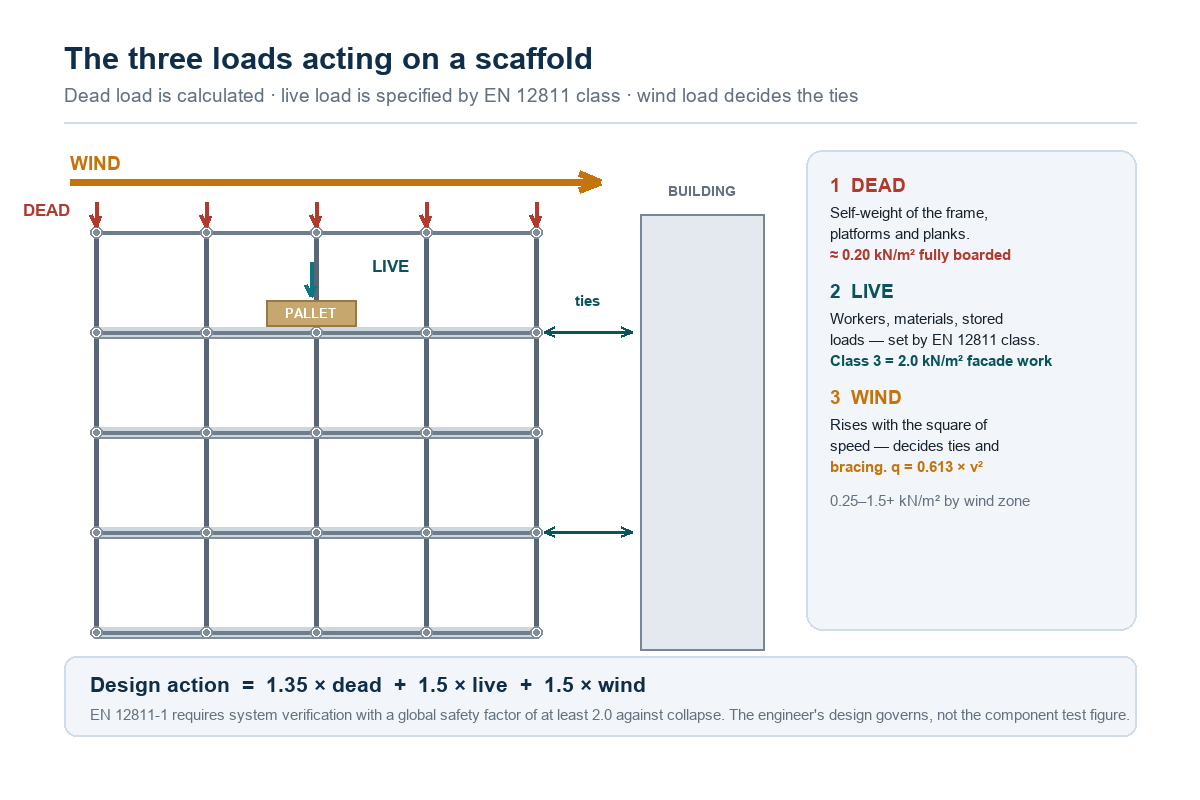
The Three Load Families at a Glance
| Load | Source | Typical magnitude | Governs |
|---|---|---|---|
| Dead | Weight of standards, ledgers, braces, planks, jacks | ≈ 20 kg/m² ≈ 0.20 kN/m² fully boarded | Standard and ledger selection |
| Live | People, tools, materials, stored loads | 0.75–6.0 kN/m² by load class | Platform decking, plank selection |
| Wind | Wind pressure on tubes, planks and netting | 0.25–1.5+ kN/m² by wind zone | Tie pattern, bracing density, anchorage |
Note the units: loads are quoted per square metre of platform for live load, and per square metre of elevation for wind. Mixing the two is the most common mistake in a hand calculation — and the reason a design should be done by an engineer working from the system's test report.
Dead Load: What the Scaffold Weighs
Dead load is the easy one, because it is the number you already calculated when you did the take-off. For the standard export grid — 1.8 m bays, 2.0 m lifts, double row, fully boarded — the structure weighs about 20 kg per square metre of facade, or 0.20 kN/m².
Two details that catch people out:
- Dead load scales with boarding, not with height. Doubling the height of a facade does not double the kg/m², because the bays, ledgers and planks scale with the area. What changes with height is the load arriving at the base — the leg load.
- The base jacks carry everything. In a 20 m high facade, the bottom standard in a loaded column carries the weight of everything above it. That is why base jack capacity, and the ground it stands on, become the limiting factors on tall work — not the tube.
Our square metres per tonne conversion gives the kg/m² figure for three boarding scenarios, so you can pick the one that matches your site.
Live Load: The EN 12811 Classes
Live load is specified, not calculated. EN 12811-1 defines six service load classes, and your project picks one — usually through the national guidance or the client's specification.
| Class | Uniformly distributed load | Typical use |
|---|---|---|
| Class 1 | 0.75 kN/m² | Inspection and very light work |
| Class 2 | 1.5 kN/m² | Light work, single trade |
| Class 3 | 2.0 kN/m² | General facade access — the default for most projects |
| Class 4 | 3.0 kN/m² | Medium duty; materials staged on the platform |
| Class 5 | 4.5 kN/m² | Heavy duty, industrial work |
| Class 6 | 6.0 kN/m² | Very heavy duty, storage and plant |
Two things the class does not mean:
- It is not the weight the platform can be loaded to by default. The class defines the design basis the engineer works to; the permissible load on the erected structure depends on the bay grid, lifts and tie pattern in that specific design.
- A uniform load assumption is not the whole check. The standard also requires the decking to carry a local concentrated load — a single heavy foot or a wheel — which is why a thin plank can pass on paper and still fail on site.
The full standard picture, including how EN 12810 and EN 12811 divide the responsibilities, is covered in our guide to the EN 12810 / EN 12811 standards.
Wind Load: The Load That Decides Your Ties
Wind pressure rises with the square of wind speed:
q = 0.613 × v² (v in m/s → q in N/m²)
| Wind speed | Dynamic pressure | Approximate |
|---|---|---|
| 20 m/s (72 km/h) | 245 N/m² | 0.25 kN/m² |
| 30 m/s (108 km/h) | 552 N/m² | 0.55 kN/m² |
| 40 m/s (144 km/h) | 981 N/m² | 0.98 kN/m² |
| 50 m/s (180 km/h) | 1,533 N/m² | 1.53 kN/m² |
That doubling is why a scaffold that is perfectly stable in a sheltered inner-city courtyard has to be redesigned for a coastal high-rise. Three multipliers sit on top of the basic pressure in a real calculation:
- Shape and gust factors — tube-and-plank elevations are aerodynamically blunt, so the effective pressure is higher than the raw dynamic pressure.
- Solidity ratio — an unboarded frame lets wind through; debris netting or sheeting turns it into a solid sail. Netting is the single biggest change a site can make to the wind load on a frame, and it is routinely added after the design is fixed.
- Height and terrain — pressure increases with height above ground and in exposed terrain.
Wind load is resisted by two things: the ties that anchor the scaffold to the building, and the diagonal bracing that keeps the frame from racking. Tie frequency is therefore a design output, not a site preference — and "we tie it where we can reach" is how scaffolds come down.
How the Loads Are Combined
| Action | Partial safety factor | Notes |
|---|---|---|
| Dead (permanent) | ≈ 1.35 | Weight of structure, platforms, permanent attachments |
| Live (variable) | ≈ 1.5 | Workers, materials, stored loads |
| Wind (variable) | ≈ 1.5 | Rarely combined at full value with the full live load |
On top of the partial factors, EN 12811-1 requires the system as a whole to be verified with a global safety factor of at least 2.0 against collapse. In practice that reserve is embodied in the system's test data: a ringlock node that is tested to carry 24 kN, for example, is designed for a working leg load far below it.
What this means commercially: the number that matters on a quotation is not a load figure, it is the test report behind it. A supplier who can produce EN 12810 / EN 12811 system test data on the exact tube specification you are buying is giving you the only evidence that the load capacity is real.
Three Misconceptions Worth Killing
- "Ringlock carries 24 kN per leg, so I can load it however I like." That is a component figure from a specific test. Permissible load depends on the grid, the number of lifts, the tie pattern and the foundation.
- "More planks means a stronger platform." More planks means more dead load and a higher wind sail area. Boarding only the working lifts is a legitimate and sometimes better engineering choice.
- "Taller scaffold, bigger tubes." Height changes where the load goes — to the base, the ties and the ground — but the tube section stays the same. The fix for height is foundations and tie design, not thicker steel.
What to Ask For When You Buy
Whether you are buying for a fleet or for a single project, the load conversation ends in documents. Ask for:
- The system test report to EN 12810 / EN 12811-1, covering the exact tube specification and component range you are purchasing
- Unit weights per component, so you can verify the dead load in your own take-off rather than accepting a coefficient
- The galvanizing thickness report to EN ISO 1461 — corrosion is a slow-motion load failure, and the standards explained article sets out what else to check
Send us your project parameters — facade area, height, load class and wind zone — and we will return a take-off with the corresponding tonnage and the system documents for your engineer to design against. Request system documentation →
If you are still sizing the structure, start with the quantity take-off formula — it produces the dead load figure this article uses. The ringlock scaffolding system page lists the components those loads are distributed across.
Frequently Asked Questions
What are the three types of load on a scaffold?
Dead load (the weight of the structure itself), live load (workers, materials and equipment on the platforms) and wind load (the environmental action that drives the tie and bracing design). Wind is usually the load that decides the layout.
What is the dead load of scaffolding?
For ringlock at the export-standard grid the self-weight is about 20 kg/m² of facade when every lift is boarded — roughly 0.20 kN/m². It carries a partial safety factor of about 1.35 in design.
Which EN 12811 load class should I specify?
Class 3 (2.0 kN/m²) covers most facade access work. Move to Class 4 (3.0 kN/m²) where materials and pallets are staged on the platform, and to Classes 5–6 for heavy-duty industrial and shoring applications.
How does wind load affect scaffolding?
Wind pressure rises with the square of speed (q = 0.613 × v²), so doubling wind speed quadruples the pressure. It governs how often the scaffold is tied back to the building and how much diagonal bracing is required.
What safety factors are used in scaffold design?
Eurocode-based design uses partial factors of roughly 1.35 on permanent actions and 1.5 on variable actions (live and wind). EN 12811-1 additionally requires system verification with a global safety factor of at least 2.0 against collapse.