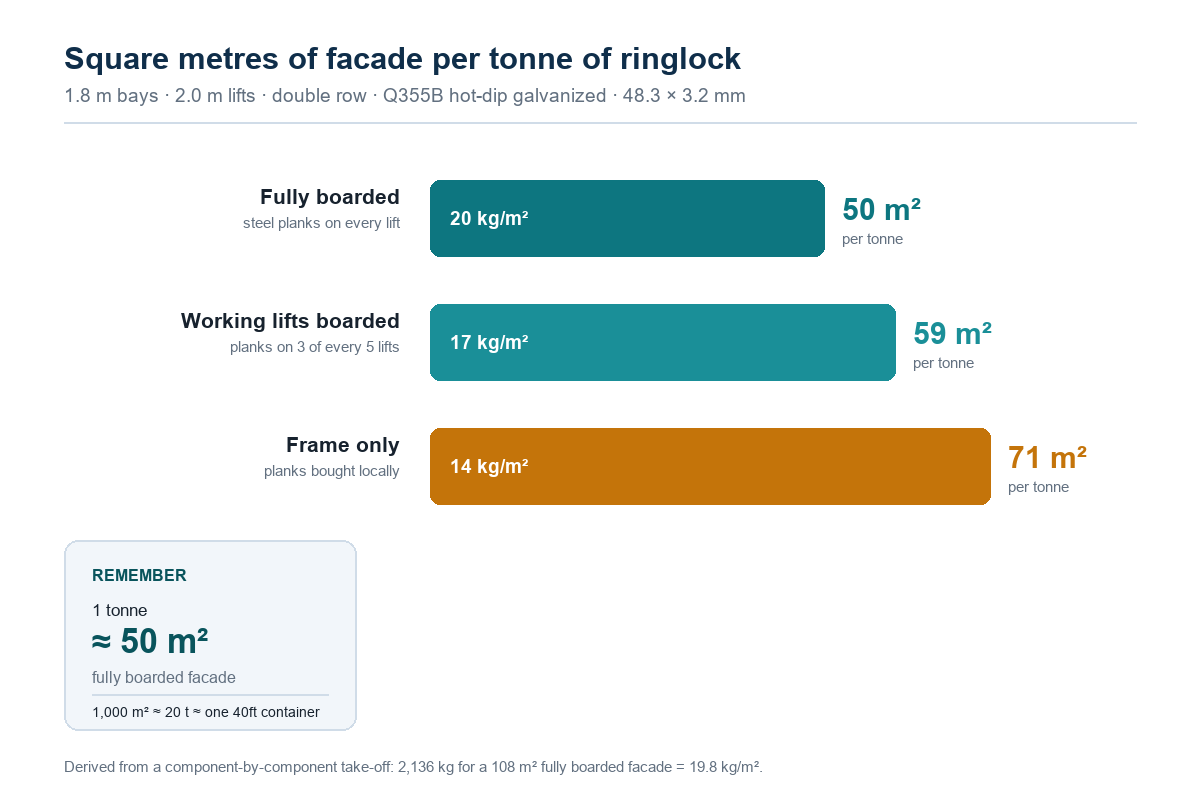
One tonne of ringlock scaffolding builds roughly 50 m² of fully boarded facade — that is the number to remember. The conversion works because the standard export grid (1.8 m bays, 2.0 m lifts, double row, Q355B hot-dip galvanized) runs at about 20 kg of steel per square metre when every lift is boarded.
Because "fully boarded" is an assumption and not a law, the honest answer is a range: 50–71 m² per tonne, depending on how much of the structure you ship and how much you buy locally. This guide gives you the tables to convert in both directions — tonnes to square metres and square metres back to tonnes — plus the piece counts that turn a tonnage into an order.
The Conversion Factor: kg of Steel per m² of Facade
Everything in this article derives from one ratio. It was calculated from a component-by-component take-off of a fully boarded facade — the same 20 tonnes per 1,000 m² that our quantity take-off formula arrives at from the other direction.
| Loading scenario | kg per m² | m² per tonne | What it assumes |
|---|---|---|---|
| Fully boarded | ≈ 20 kg/m² | ≈ 50 m²/t | Steel planks on every lift, 1.8 m bays, 2.0 m lifts |
| Working lifts boarded | ≈ 17 kg/m² | ≈ 59 m²/t | Planks on 3 of every 5 lifts — the common site compromise |
| Frame only | ≈ 14 kg/m² | ≈ 71 m²/t | Standards, ledgers, braces and jacks; planks sourced locally |
The gap between the top and bottom row is entirely boarding: steel planks are close to 30% of the tonnage in a fully boarded facade, which is why the frame-only figure stretches so much further.
If you need a single number for a budget, use 20 kg/m² and 50 m² per tonne. It is the conservative end, it matches what suppliers quote against, and it will not leave you short.
Tonnes You Need for Common Facade Sizes
Read the table left to right to size a project, or right to left to see how far a container goes.
| Facade area | Fully boarded (20 kg/m²) | Working lifts (17 kg/m²) | Frame only (14 kg/m²) |
|---|---|---|---|
| 250 m² | 5.0 t | 4.3 t | 3.5 t |
| 500 m² | 10.0 t | 8.5 t | 7.0 t |
| 1,000 m² | 20.0 t | 17.0 t | 14.0 t |
| 2,000 m² | 40.0 t | 34.0 t | 28.0 t |
| 5,000 m² | 100.0 t | 85.0 t | 70.0 t |
Two reference points make this concrete. 1,000 m² is one 40ft container — 20 tonnes is exactly the practical payload our container loading guide plans around. And a 5,000 m² high-rise facade is five containers: at that scale the conversion stops being an estimate and starts being a shipping schedule.
What One Tonne Actually Contains
Tonnes are what you pay for; pieces are what arrives. Dividing 1,000 kg by the unit weight of each component gives the count per tonne. All weights are from our certified range and are listed in the ringlock size chart.
| Component | Spec | Unit weight | Pieces per tonne |
|---|---|---|---|
| Standards | 2.0 m | 9.7 kg | ≈ 103 |
| Standards | 3.0 m | 14.3 kg | ≈ 70 |
| Ledgers | 1.8 m | 7.3 kg | ≈ 137 |
| Ledgers | 1.2 m | 5.1 kg | ≈ 196 |
| Diagonal braces | 1.8 × 2.0 m bay | 8.5 kg | ≈ 118 |
| Steel planks | 1.8 m | 11 kg | ≈ 91 |
| Adjustable base jacks | 0–600 mm travel | 5.6 kg | ≈ 179 |
The 3.0 m standard row is the one worth checking on a quotation. Long standards cut the number of joints per column, but they also load the container differently — see the loading guide for how 3.0 m lengths are bundled and blocked.
Why the Figure Moves: Four Variables
The kg/m² ratio is stable enough to budget with, but four things shift it:
- Bay length. Wider bays (2.4 m) need fewer standards, so steel per m² falls; narrower bays (1.5 m) push it up. The effect is worth roughly ±15% on material.
- Lift height. Taller lifts mean fewer levels of ledgers and fewer platforms — lighter overall, but each platform carries more workers. Shorter lifts raise the steel per m² and the load capacity.
- Boarding extent. Every boarded lift adds roughly 11 kg per 1.8 m bay. Boarding 10 lifts instead of 6 is a 30% swing on a small facade.
- Unit weight of the tube. A 2.0 m standard in 3.2 mm wall Q355B weighs 9.5–10 kg. If a quotation implies 7 kg, it is describing a thinner tube — your container looks like a bargain and your load class is gone.
Using the Conversion Before You Have a Drawing
The ratio is designed for the stage where you know the facade but not the layout. Divide the area by 50 and you have a working tonnage; multiply by 20 and you have a weight to price against. Two worked shortcuts:
- Preliminary budget. 3,200 m² of facade ÷ 50 = 64 t. At an indicative range of $1,000–1,400 per tonne FOB for hot-dip galvanized ringlock, that is a $64,000–$90,000 material budget before freight — our price guide explains why a single number is never published.
- Container planning. 64 t ÷ 22–24 t per 40ft container = 3 containers, with the balance made up by accessories, planks or a fourth part load.
Both shortcuts assume the standard grid. The moment the engineer fixes a different bay and lift combination, go back to the take-off, because the per-component rules there are exact and this ratio is not.
From Square Metres to a Container
The conversion does one more job: it tells you when an order stops being a container and becomes a programme. Up to about 1,200 m² you are shipping one box. Beyond that, phased deliveries usually beat a single large shipment, because storage on site is the constraint that damages steel long before sea freight does.
Send us the facade area and the number of lifts you intend to board. We will convert it to tonnage, confirm how many containers it needs and return an indicative quotation — the take-off is prepared free of charge. Send your facade area →
Working from the other direction? Our ringlock scaffolding system page lists the component range with the unit weights used throughout this article.
Frequently Asked Questions
How many square metres does one tonne of scaffolding cover?
About 50 m² of fully boarded facade at the export-standard grid (≈ 20 kg/m²). The same tonne reaches roughly 59 m² when only the working lifts are boarded, and up to 71 m² when planks are bought locally and only the frame is imported.
How many tonnes of scaffolding do I need for 1,000 m²?
About 20 tonnes fully boarded — effectively one 40ft container. Budget 17 t if only working lifts are boarded, or 14 t for a frame-only order.
What does scaffolding weigh per square metre?
Approximately 20 kg/m² of facade when every lift is boarded, 17 kg/m² with three of five lifts boarded, and 14 kg/m² for the frame alone. The exact figure depends on bay length, lift height and how many lifts carry planks.
How many pieces of scaffolding are in one tonne?
Count on roughly 103 lengths of 2.0 m standard, 137 × 1.8 m ledgers, 196 × 1.2 m ledgers, 91 × 1.8 m steel planks or 118 diagonal braces per tonne, based on certified unit weights.
Why do suppliers quote different square-metre figures per tonne?
Because the figure depends on assumptions, not constants: the bay grid, how many lifts are boarded, whether planks are included, and the unit weight of the tube. Always ask which of those the number is based on before comparing.